Form IL-1310, officially titled “Statement of Person Claiming Refund Due a Deceased Taxpayer,” is a document issued by the Illinois Department of Revenue. Its purpose is to allow a surviving spouse, personal representative, or another claimant to request a refund that the deceased taxpayer was entitled to receive. When a taxpayer passes away before receiving their Illinois state income tax refund, the person or entity authorized to claim that refund must submit this form along with the decedent’s final Form IL-1040 (Individual Income Tax Return).
If you are a surviving spouse filing jointly, you do not need to file Form IL-1310. However, if you’re filing a separate return or are not the spouse, this form is mandatory. The proof of death—such as a death certificate or an official Department of Defense notification—must be attached.Additionally, if you are claiming the refund, you must list the return “in care of” your name and address and write “deceased” along with the date of death above the taxpayer’s name on the Form IL-1040.
How To File Form IL-1310
- Attach Form IL-1310 to the deceased person’s Form IL-1040 (Individual Income Tax Return).
- Provide proof of death—a death certificate or other accepted documentation.
- Check your eligibility:
- Surviving spouse (not filing a joint return)
- Court-appointed personal representative
- Other authorized claimant for the estate
- Mail the documents to the Illinois Department of Revenue, following the same mailing instructions as the standard IL-1040 return.
- Keep a copy of all submitted forms and documentation for your records.

How To Complete Form IL-1310
Follow these steps exactly as they appear on the form.
Step 1: Provide the Claimant’s Information
Line 1: Claimant’s Social Security or Federal Employer Identification Number
Enter your Social Security Number (SSN) if you are an individual, or your Federal Employer Identification Number (FEIN) if you are representing an estate, trust, or organization.
Line 2: Claimant’s Name
Write your full legal name exactly as it appears on your identification or legal documents.
Line 3: Street Address
Provide your current street address, including any apartment or unit numbers. This is where any correspondence or refund check will be sent.
Line 4: City, State, ZIP Code, and Daytime Phone Number
List your city, state, and ZIP code, followed by your daytime phone number where the Department of Revenue can reach you if clarification is needed.
Line 5: Filing Status — Select One Option
You must check only one box to identify your relationship to the deceased taxpayer:
- Box (a): Surviving Spouse
Choose this if you are the surviving spouse claiming a refund for your deceased spouse’s separate tax return and no personal representative has been appointed by the court.
➤ You must complete Schedule A and attach proof of death. - Box (b): Personal Representative
Check this if you are the executor, executrix, administrator, or administratrix of the deceased person’s estate and have been formally appointed by the court.
➤ Attach a court certificate showing your appointment.
A copy of the will alone is not acceptable. - Box (c): Other Claimant For The Estate
Select this if you are not a surviving spouse or court-appointed personal representative but are legally entitled to claim the refund on behalf of the estate.
➤ Complete Schedule A and attach proof of death.
Certification Section
At the bottom of Step 1, sign and date the form:
- Signature of Claimant – You must sign to confirm that the information provided is true, correct, and complete.
- Date – Write the date you are signing the form.
Your signature certifies the claim under penalty of perjury.
Step 2: Provide the Deceased Taxpayer’s Information
Line 6: Deceased Taxpayer’s Social Security Number
Enter the Social Security Number of the deceased taxpayer.
Line 7: Deceased Taxpayer’s Name
Write the full legal name of the deceased person exactly as it appeared on their tax documents.
Line 8: Street Address
Enter the permanent residence or domicile address of the deceased taxpayer at the date of death.
Line 9: City, State, ZIP Code
Provide the city, state, and ZIP code of the deceased taxpayer’s residence at the time of death.
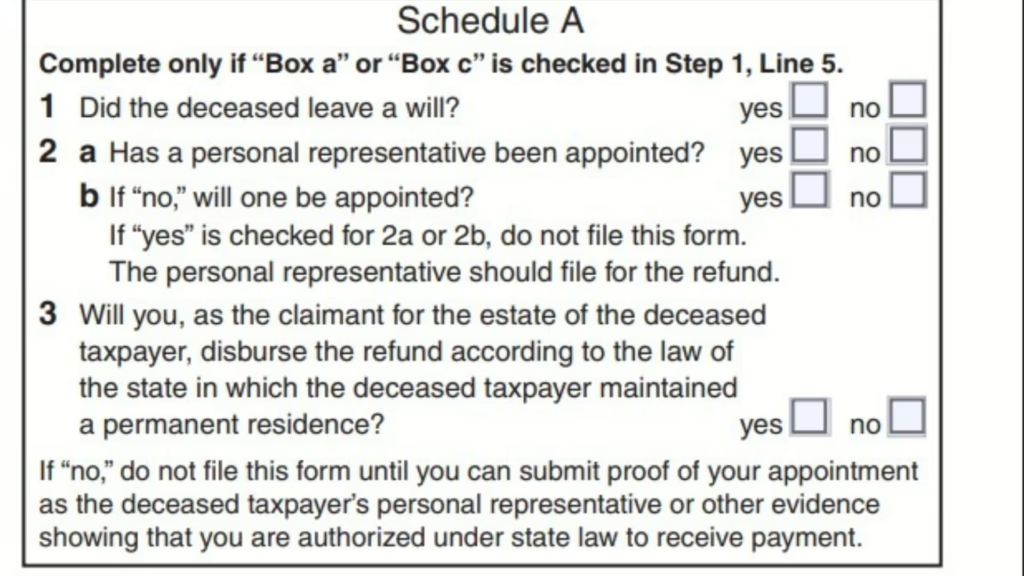
Schedule A (Complete Only If Box A or Box C Is Checked)
This section determines whether you are authorized to claim the refund if no personal representative is appointed.
Question 1: Did the Deceased Leave a Will?
Check “Yes” or “No.”
If you answer “Yes,” it helps confirm whether a representative might be appointed later.
Question 2a: Has a Personal Representative Been Appointed?
Check “Yes” or “No.”
- If “Yes,” do not file this form—the personal representative must file for the refund.
Question 2b: Will One Be Appointed?
If you answered “No” to 2a, indicate here whether one will be appointed.
- If you answer “Yes”, again, do not file this form; the representative will handle the refund.
Question 3: Are You Authorized To Disburse The Refund?
Answer “Yes” or “No.”
If you check “Yes”, you confirm that you will disburse the refund according to the laws of the state where the deceased taxpayer resided.
If you check “No,” you must wait to file this form until you can submit proof of your legal appointment or authorization to receive the payment.
General Information Summary
- Purpose: Allows a surviving spouse, personal representative, or estate claimant to receive a deceased taxpayer’s refund.
- Who Must File: Anyone claiming a refund on behalf of a deceased person except a surviving spouse filing jointly.
- Proof of Death: Attach a death certificate or official Department of Defense notice.
- Form IL-1040: Always attach Form IL-1310 to the decedent’s final IL-1040 return.
- Legal Authority: Required under the Illinois Income Tax Act. Failure to provide full information may result in penalties.